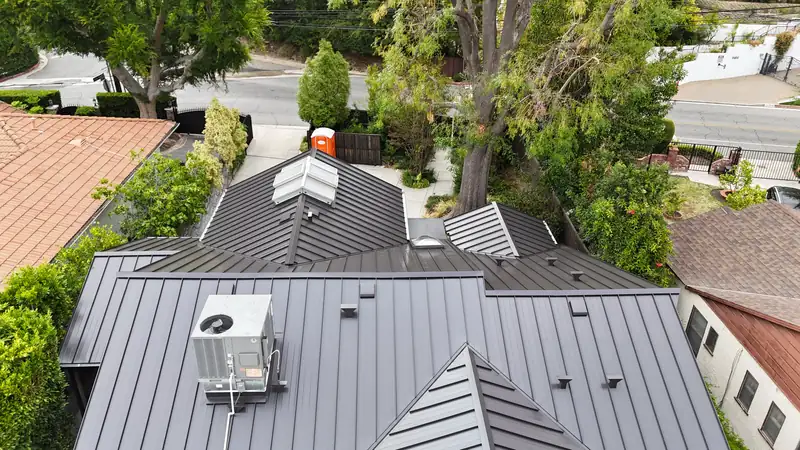
Brentwood and Wildfire: The Plain Facts
Brentwood sits where the city meets open brush land. The neighborhoods north of Sunset Boulevard, including Mandeville Canyon, Kenter Canyon, Sullivan Canyon, Crestwood Hills and the streets off Tigertail Road, climb into canyons that run up into the Santa Monica Mountains. That landscape is a large part of why people love living here, and it is also why fire is part of planning a roof.
The area has real history with fire. The 1961 Bel Air fire burned through Bel Air and Brentwood and destroyed hundreds of homes, including houses in Crestwood Hills. In October 2019 the Getty Fire started beside the 405 near the Getty Center, burned about 745 acres and destroyed homes on Brentwood hillside streets. In January 2025 the Palisades Fire, which burned more than 23,000 acres to the west, brought evacuation orders into Brentwood, and firefighters worked its eastern edge in the Mandeville Canyon area.
None of that is meant to alarm anyone. It is the context that Los Angeles building rules are written around, and it is why we treat the roof on a Brentwood hillside home as one part of a bigger plan.
Check Whether Your Home Is in a Fire Hazard Zone
California maps Fire Hazard Severity Zones, and the City of Los Angeles shows them parcel by parcel. Much of Brentwood north of Sunset is in a Very High Fire Hazard Severity Zone. To check your own lot, look up your address on the city's ZIMAS map and look for the fire hazard field. We check it for every Brentwood estimate, because it changes what the roof has to meet.
What a Class A Rating Means
Roof coverings are fire tested and rated Class A, B or C, with Class A the highest. The tests look at how well a roof resists fire spreading across its surface and how well it resists a burning brand landing on it.
The rating belongs to the assembly, not just the top layer. Metal panels are noncombustible on their own, but a Class A rating for a standing seam roof is usually earned as a tested combination of panel, underlayment and deck. That is why we specify the underlayment for a fire zone home as carefully as the panels, and why a metal roof installed over the wrong layers is not automatically Class A.
In short: metal does not burn. A Class A rated metal roof is metal installed as a tested system. Ask any roofer which assembly gives the rating on your house.
What California's Wildfire Building Rules Ask of a Roof
California's building code has a chapter written for homes in fire hazard areas: Chapter 7A of the California Building Code, carried into the California Residential Code as Section R337. It covers roofs, vents, eaves, gutters, windows, decks and siding. For roofs in a Very High Fire Hazard Severity Zone, the key points are:
- Class A roofing. State law requires a Class A roof on new roofs in these zones, and on re-roofs that replace a large part of an existing roof.
- Closed gaps. Spaces between the roof covering and the deck, such as the open ends of panels at the eaves, have to be closed off so embers cannot get in.
- Protected valleys. Valley flashings get a noncombustible metal and an extra layer underneath.
- Vents that resist embers. Attic and ridge vents have to be designed to resist ember and flame intrusion.
- Gutters that stay clear. Gutters need a way to prevent leaves and needles from building up in them.
The exact requirements for your house depend on its zone, its age and the scope of work, and the Los Angeles Department of Building and Safety decides what applies when the permit is issued. We plan the roof to meet the rules at permit time rather than finding out at inspection.
Where Roofs Are Most Vulnerable
Fire researchers and fire departments say the same thing: during a wildfire, most homes catch fire from embers, not from a wall of flame. Embers can travel a long way ahead of a fire front. They settle where debris collects and where there are small openings. On a roof, those places are predictable:
- Valleys and the area behind chimneys, where leaves and needles pile up.
- Gutters full of dry debris along the eaves.
- Open panel ends at the eaves and ridge, if they are not closed off.
- Attic and ridge vents that let embers into the attic.
- The joint between a roof and a wall, where a second story or a chimney meets the roof.
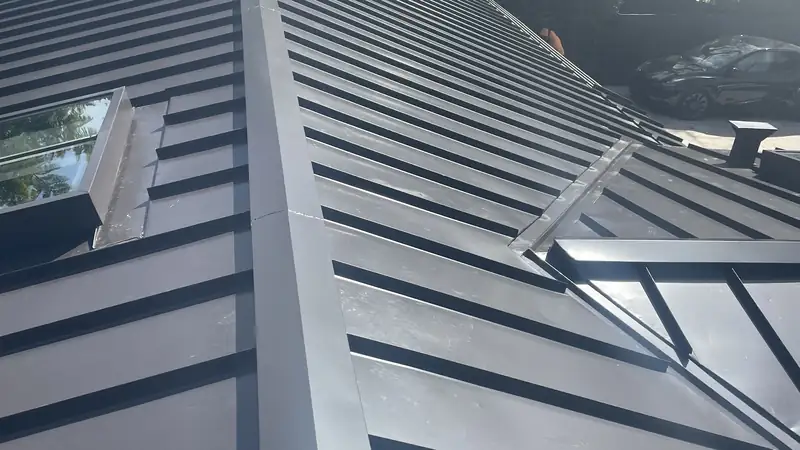
A standing seam roof helps with several of these at once. The surface is smooth and noncombustible, so it sheds debris rather than holding it. The panel ends at eaves and ridges can be closed with metal closures. And the trim at valleys, walls and edges is formed from the same metal as the panels.
Brush Clearance and Roof Maintenance
A roof is one part of the picture. The Los Angeles Fire Department enforces brush clearance in the city's high fire hazard areas, including hillside Brentwood, and its rules include keeping roof surfaces free of a build-up of leaves, needles and twigs and keeping trees trimmed back from chimneys. You can read the full requirements on the LAFD brush clearance page.
On a metal roof, that maintenance is simpler. Most debris slides off on its own, and what is left in valleys and gutters is easy to clear. We recommend a look after the windy months and before the dry season, especially under big trees.
How We Build a Fire-Resistant Metal Roof in Brentwood
- Confirm the zone. We check your parcel on ZIMAS and note it on the scope.
- Specify the assembly. Panel, underlayment and deck combination chosen for a Class A rating.
- Close the gaps. Metal closures at eaves and ridges, so there are no open panel ends for embers to enter.
- Detail the valleys and walls. Noncombustible valley metal, wall flashings and chimney flashings formed in our shop.
- Coordinate vents and gutters. We point out vents and gutters that may need ember-resistant upgrades and work them into the plan.
- Permit and inspection. We pull the LADBS permit and call for the inspection.
For the full replacement process, see metal roof replacement in Brentwood.
Questions to Ask About a Fire-Rated Roof Bid
If your home is in a fire hazard zone, a few questions will tell you whether a roofing bid has really been built around that:
- Which tested assembly gives this roof its Class A rating, and which underlayment does it need?
- How will the open ends of the panels at the eaves and ridge be closed off?
- What will be used in the valleys, and what goes underneath it?
- Are the existing attic and ridge vents suitable, or should they be upgraded at the same time?
- Do the gutters need guards or a different profile to stay clear of leaves and needles?
- Has the parcel's fire hazard zone been checked, and is it noted on the scope?
We answer every one of these in writing as part of our scope, so you can compare bids on the same terms.
What a Metal Roof Does Not Do
No roof makes a house fireproof, and we will not tell you otherwise. A Class A metal roof removes one of the most common ways a house catches fire. It works best alongside cleared brush, ember-resistant vents, protected eaves and windows, and a plan for the area right around the house. We are happy to walk through the roof side of that with you, honestly and without pressure.
To learn more about Eclipse Metal Roofing, visit eclipsemetalroofing.com, or call (424) 541-1385 to book an on-site estimate in Brentwood.